|
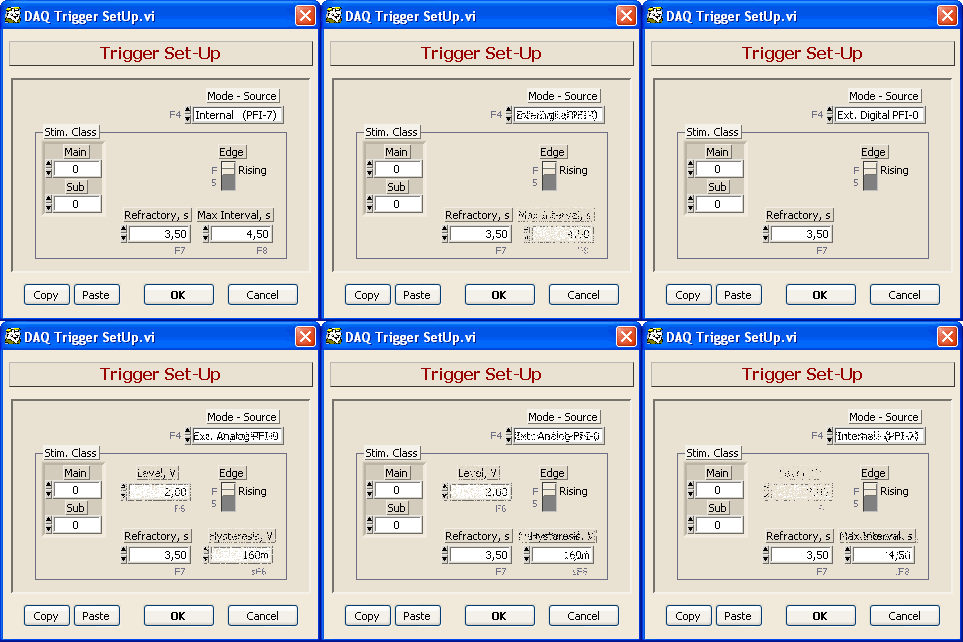
The acquisition of sweeps along with event timing and analog output may
be trigged in three different ways - modes - each has its own set of parameters.
These are specified here:
- Trigger Mode - Source
- Classification
- Internal Trigger Parameters
- External Digital Trigger Parameters
- External Analog Trigger Parameters
- Copy and Paste
Trigger Mode - Source
The trigger mode is specified via the Mode - Source control. Basically
Mr. Kick supports three different trigger modes:
- Internal Digital: The trigger is automatically generated by
the program at specified intervals.
- External Digital: The trigger must be supplied from external
equipment and it must be TTL compatible (digital). One out of six input
lines can be software selected as the trigger input.
- External Analog: The trigger must be supplied from external
equipment to PFI line #0. An analog signal in the range from -10 to
+10 V may be supplied. The use of this mode suffers from a number of
restrictions, see below!
The acquisition of sweeps may be delayed relative to the incoming trigger
when internal or external digital mode is in use. This is specified via
event timer no. zero under Settings -
Event Timing. No delay is available in external
analog mode!
Note: During upstart of the program event timer outputs will
change state, and eventually trigger external equipment!
Classification
Trigger parameters are subject to classification: The different parameters
for each of the trigger modes may vary over classes. To achieve this select
the Stimulus Type and Act On - Trigger option in the Classification settings.
Choose which class to set parameters for via the Stim. Class control.
Trigger Mode - Source is the same for all classes.
Internal Trigger Parameters
Each sweep may be trigged internally at a certain interval specified
by the Refractory and Max. Interval parameters:
The time interval between two sweeps will be at least as long as the Refractory
period, and in general no longer than the Max. Interval. To avoid anticipation
this interval is randomized within that range, e.g. from 2.5 to 4.0 seconds.
The refractory period is defined as the minimum time from the trig of
the actual sweep (time zero) till the next sweep can be trigged.
In practice the interval may be longer if the acquisition of the sweep
or analog output or event timing can not finish within the set limits.
In this case Mr. Kick will acquire sweeps as fast as possible.
Trig Edge is ignored.
For the internal trigger to work some external
connection must be made on the MIO-board.
External Digital Trigger Parameters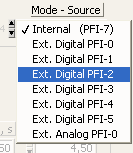
There are six inputs available for external digital triggers. They are
labeled PFI-0 through PFI-5 on the MIO-board. All inputs are TTL compatible,
and you may choose to trig on a rising or falling edge as specified by
the Edge parameter.
Mr. Kick will not react to any triggers in the refractory period set
via the Refractory parameter. This period is measured from the trig of
the actual sweep (time zero) till the following sweep can be trigged.
As with internal triggers other parameters may influence the real minimum
interval between accepted triggers: If the acquisition of the sweep or
analog output or event timing can not finish within the set period, the
refractory period will be prolonged accordingly. Set Refractory to zero
or anything shorter than the post sweep period and Mr. Kick will acquire
sweeps as fast as possible.
External Analog Trigger Parameters
Restrictions
Analog trig has caused severe problems throughout the implementation
of Mr. Kick. As a result some restrictions are applied on the use of analog
trig:
- Due to hardware limitations this trig mode can only be applied safely
when triggers occur at intervals sufficiently longer than the time it
takes Mr. Kick to get ready for another sweep (depends on the computer
in use).
- The acquisition of sweeps can not be delayed through event
timer no. zero as with internal and external digital trigger modes.
- The trigger edge (falling or rising) can not be controlled on PCI-MIO16E-4
boards, revision A-C, unless you set a pretty high hysteresis level
- go here for more information.
A separate page is dedicated to a full description
of the problems as well as possible solutions - this is important
reading, if you'll use analog trig!
The Use
If the trigger mode is set to External Analog the PFI line #0 will act
as an analog trigger input accepting signals in the range from -10 to
+10 V. The trigger level is specified in Volts via the Level control.
Also hysteresis may be introduced in order to avoid false triggers due
to noise.
You may choose to trig on a rising or falling edge via the Edge control.
This will not work on PCI-MIO16E-4 boards,
revision A-C! Go here for more information.
Mr. Kick will not react to any triggers in the refractory period set
via the Refractory parameter. This period is measured from the trig of
the actual sweep (time zero) till the following sweep can be trigged.
Copy and Paste
If more classes share almost the same settings, you may copy all settings
from one class to another.
|